
Mon-Fri | : 9:00am - 1:00pm 2:00pm - 5:00pm |
Sat | : 9:00am - 12:00pm |
Sun/PH | : Closed |
2:00pm - 5:00pm







Prostate Cancer Treatment in Singapore
Prostate cancer is one of the most common cancers affecting men in Singapore, particularly those aged 50 years and above. According to the National Cancer Centre Singapore, it was the most commonly diagnosed cancer among men between 2019 and 2023, accounting for 18% of all male cancers.
Many men with early prostate cancer experience no noticeable symptoms, making timely medical evaluation and discussions about screening important, particularly for those with risk factors or a family history of the disease.

Dr Michael YC Wong, Medical Director & Senior Consultant Urologist
FAMS (Urology), FICS (USA), FRCS (Edinburgh), M Med (Surgery), MBBS (Singapore)

What Is Prostate Cancer?
Prostate cancer occurs when cells within the prostate gland begin to grow abnormally and form a tumour. The prostate is a small gland in the male reproductive system that produces seminal fluid and is located below the bladder, surrounding part of the urethra.
Not all prostate cancers behave in the same way. Some remain confined to the prostate and progress slowly, while others are more aggressive and can spread to nearby tissues, lymph nodes or other parts of the body. Determining the type and extent of the cancer plays an important role in guiding treatment recommendations.
Types Of Prostate Cancer

Adenocarcinoma
Neuroendocrine Carcinomas
Transitional Cell Carcinomas
Sarcomas
Who Is at Risk of Prostate Cancer?
Age
Family History
Inherited Genetic Mutations
Ethnic Background
Dietary Factors
Lifestyle Factors
Signs and Symptoms of Prostate Cancer
Many men with early-stage prostate cancer do not experience noticeable symptoms. When symptoms do occur, they often resemble those of other prostate conditions, such as benign prostatic hyperplasia (BPH). As the cancer progresses, urinary symptoms and other signs may become more apparent.

Frequent urination, especially at night
Weak urinary stream
Blood in urine or semen
Pain in the lower back or hip area
Burning or pain during urination
Erectile dysfunction
Unexplained weight loss and loss of appetite
Difficulty controlling the bladder or bowels
Symptoms alone cannot confirm prostate cancer, and many overlap with other benign prostate conditions. If you notice persistent urinary symptoms, blood in your urine or semen, or have a family history of prostate cancer, it is advisable to consult a urologist for further evaluation.
When Should You See a Prostate Cancer Specialist?
You should consider seeing a urologist if you experience:
- Persistent urinary symptoms such as a weak stream, frequent urination or difficulty emptying your bladder
- Blood in your urine or semen
- Persistent pain in the pelvis, hips or lower back
- An elevated PSA level or abnormal digital rectal examination (DRE)
- A strong family history of prostate cancer or inherited genetic mutations associated with increased risk
- Ongoing concerns about your prostate health or whether prostate cancer screening is appropriate
Prompt assessment can help determine the cause of your symptoms and whether further investigations are required.
Early detection can significantly improve treatment outcomes for prostate cancer. Schedule a consultation with Dr Michael Wong for a comprehensive diagnosis today.
How Is Prostate Cancer Diagnosed?
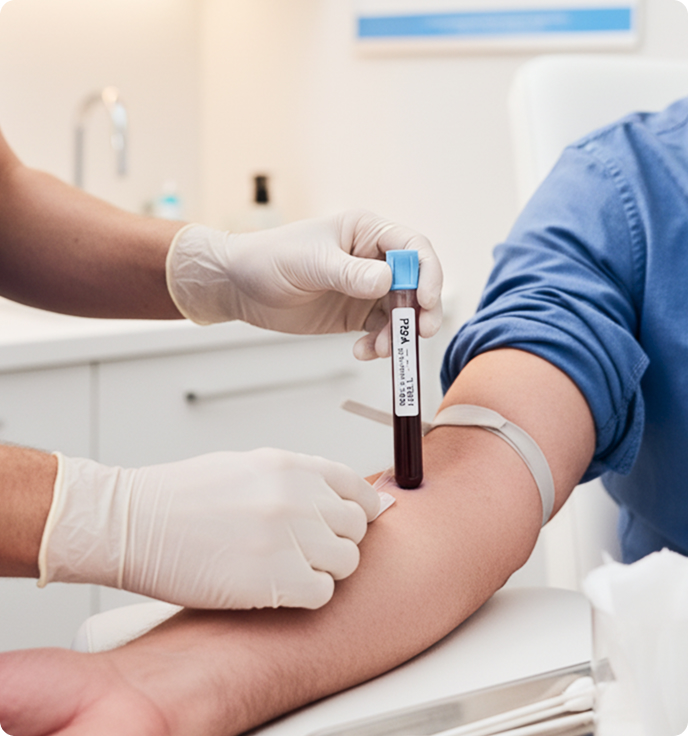
Prostate-Specific Antigen (PSA) Test
The PSA test measures the level of prostate-specific antigen in the blood. While elevated PSA levels may be associated with prostate cancer, they can also occur due to benign prostate enlargement, prostatitis or other prostate conditions. The result is therefore interpreted alongside other clinical findings.
Digital Rectal Examination (DRE)
During a DRE, the urologist gently examines the prostate through the rectum to assess its size, shape and texture. This helps identify abnormalities such as hard areas or irregularities that may require further investigation.
Multiparametric MRI (mpMRI)
A multiparametric MRI provides detailed images of the prostate and helps identify suspicious areas that may require biopsy. It is commonly performed before biopsy to improve cancer detection and guide tissue sampling.
Prostate Biopsy
A prostate biopsy remains the definitive test for confirming prostate cancer. Small tissue samples are collected from the prostate, usually under ultrasound or MRI guidance, and examined under a microscope to determine whether cancer cells are present and how aggressive they appear.
Additional Imaging for Prostate Cancer Staging
Additional imaging may be recommended to assess the extent of the cancer following diagnosis. These scans help determine whether the disease remains confined to the prostate or has extended beyond the gland.
Multiparametric MRI (mpMRI)
A multiparametric MRI provides detailed images of the prostate and surrounding structures. Following a prostate cancer diagnosis, it helps assess whether the cancer has extended beyond the prostate capsule or into nearby tissues, which is important when planning treatment.
CT Scan
A CT scan uses X-rays to produce detailed cross-sectional images of the body. It may be recommended to evaluate the lymph nodes, pelvis and other organs for evidence of cancer spread.
Bone Scan
A bone scan may be performed for patients with higher-risk or advanced prostate cancer to determine whether the cancer has spread to the bones, one of the most common sites of metastasis.
PSMA PET/CT Scan
For selected patients, particularly those with intermediate or high-risk prostate cancer, a PSMA PET/CT scan may be recommended. This specialised imaging test detects prostate cancer cells with greater sensitivity than conventional imaging and can help identify the extent of disease or detect recurrent cancer after treatment.
What Are the Stages of Prostate Cancer?
Stage I
Stage II
Stage III
Stage IV
How Doctors Decide on the Most Appropriate Treatment
Prostate cancer treatment is individualised, as no single approach is suitable for every patient. Your urologist will consider several factors before recommending a treatment plan, including:
After discussing the potential benefits, risks and expected outcomes of each option, your urologist will recommend an approach that is most appropriate for your individual circumstances.
What Are the Treatment Options for Prostate Cancer?
Active Surveillance
Active surveillance involves closely monitoring low-risk prostate cancer without immediate treatment. This approach may be suitable for selected patients with slow-growing cancers and typically includes regular PSA testing, digital rectal examinations, imaging and repeat biopsies where appropriate.
Radiotherapy Treatment
Radiotherapy uses high-energy radiation to destroy cancer cells while minimising damage to surrounding healthy tissue. Treatment may be delivered externally using a linear accelerator or internally through brachytherapy, depending on the characteristics of the cancer.
Hormone Therapy
Hormone therapy, also known as androgen deprivation therapy (ADT), reduces the level or effect of male hormones that stimulate prostate cancer growth. It may be used alone or in combination with radiotherapy or other treatments, particularly for more advanced disease.
Chemotherapy
Chemotherapy uses anti-cancer drugs to destroy rapidly dividing cancer cells. It is generally recommended for advanced or metastatic prostate cancer, particularly when the disease no longer responds adequately to hormone therapy.
Surgical Treatment for Prostate Cancer
Radical Prostatectomy
A radical prostatectomy involves the complete removal of the prostate gland, seminal vesicles and, in some cases, nearby lymph nodes. It is one of the main treatment options for localised prostate cancer.
Robotic-Assisted Laparoscopic Radical Prostatectomy
This minimally invasive procedure is performed using robotic-assisted technology, allowing the surgeon to operate through small incisions with enhanced precision and control. Compared with traditional open surgery, it may be associated with less blood loss, smaller incisions and a shorter hospital stay for suitable patients.
Robotic Nerve-Sparing Radical Prostatectomy
Where clinically appropriate, nerve-sparing techniques may be performed during robotic prostatectomy to preserve the nerves responsible for erectile function. Whether this approach is suitable depends on the location and extent of the cancer, as preserving cancer control remains the primary priority.
What to Expect After Prostate Cancer Treatment
Recovery varies depending on the type of treatment received and your overall health. Your urologist will provide personalised guidance throughout your recovery and arrange regular follow-up appointments to monitor your progress.
Immediately After Treatment
Patients who undergo surgery usually remain in hospital for one to three days. A urinary catheter is typically required for about one to two weeks, while discomfort and fatigue gradually improve over the first few weeks.
The First Few Weeks
Light activities such as walking are encouraged soon after treatment, while heavy lifting and strenuous exercise should be avoided until advised otherwise. Urinary leakage is common initially and often improves over time with pelvic floor exercises.
Longer-Term Recovery
Recovery of urinary continence and erectile function varies between individuals and may take several months. Patients treated with radiotherapy or hormone therapy may experience different side effects, which are monitored during follow-up consultations.
Follow-Up Care
Regular follow-up appointments are important to monitor recovery and assess treatment outcomes. PSA blood tests are commonly performed after treatment to monitor for any signs of cancer recurrence.
Frequently Asked Questions (FAQs) About Prostate Cancer
Is prostate cancer curable?
Can I check myself for prostate cancer at home?
How often should I have my prostate checked?
Can prostate cancer be prevented?
Does a high PSA mean prostate cancer?
At what stage is prostate cancer not curable?

Meet Our Prostate Cancer Specialist in Singapore
Dr Michael YC Wong
Dr Michael Wong is a senior consultant urologist with clinical expertise in the diagnosis and management of prostate cancer. He assesses men with elevated PSA levels, abnormal prostate examination findings, prostate-related symptoms and confirmed prostate cancer diagnoses, providing evidence-based recommendations tailored to each patient's clinical condition and treatment goals.
His postgraduate training in the United States includes Endourology, Female Urology, Neurourology and minimally invasive urological surgery. He also completed robotic urological surgery training at the University of California, Irvine, where he gained experience in robot-assisted radical prostatectomy and other minimally invasive surgical techniques for prostate cancer.
Let us help you
Restore your urological health.
Make an appointment with Dr Michael Wong to receive a tailored, supportive and targeted care plan.
Office
Location
3 Mount Elizabeth Road, #10-09,
Mount Elizabeth Medical Centre,
Singapore 228510
Contact
Number
Email
Address
Opening
Hours